So you want to learn this language and you don’t know where to start. What should I learn first? How can I progress? How can I get to using the language fluently? Teri and Seolhwa are here with a comprehensive roadmap to help you conquer any language. The map is divided in 3 phases of learning (beginner, intermediate and advanced) and according to the type of personality you might have (whether you are more introverted or extroverted). Let’s embark on the journey of learning a foreign language together!
Beginner phase
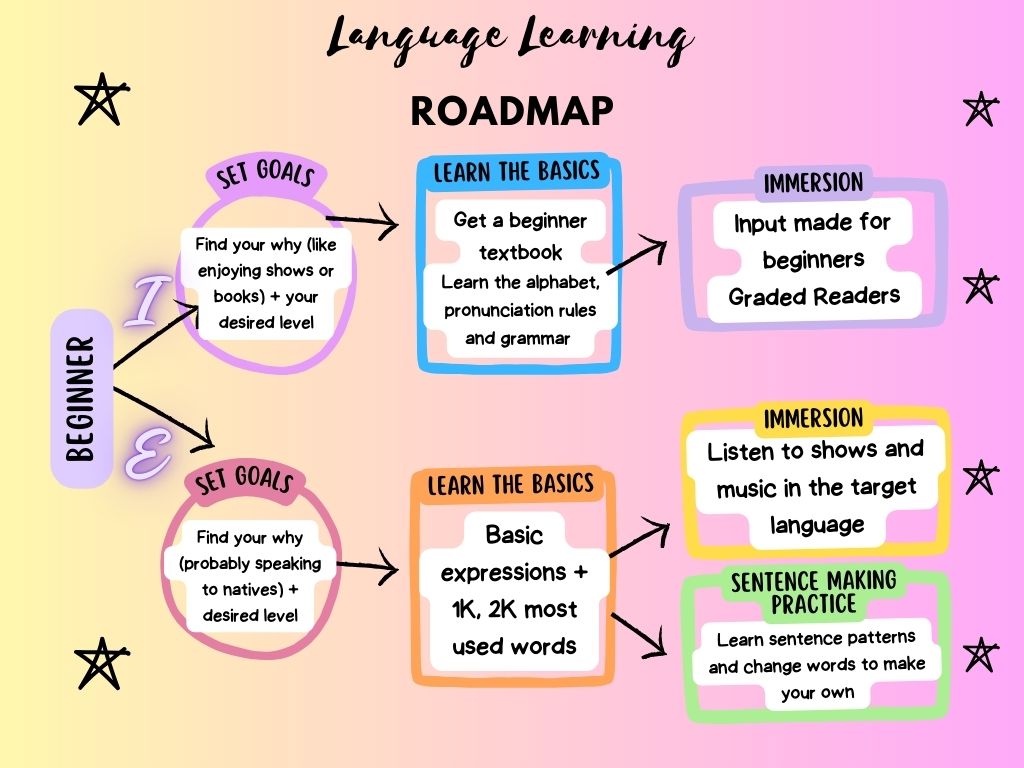
I + E- As you embark on this journey remember to be patient (language learning is a gradual process) and to be resilient (regular practice is key to progress).
~Start by setting clear goals. Ask yourself why you are learning that language, understand your motivation and decide what level of proficiency you want to achieve.
~Listen to the language to get a feel for the language (even if you don’t understand, even if it’s just with subtitles).
~Set clear goals. Ask yourself why you are learning that language, understand your motivation and decide what level of proficiency you want to achieve.
~Immerse yourself in the language by listening to music – it will help you to develop your listening skills.
I- You want to get the basics of the language and grammar in check first. You are focused more on getting to understand the language rather than being able to speak it from the start, so you get a beginner level textbook and follow it.
~After learning the basics, you can immerse yourself in input made for beginners and use graded readers.
E – You want to start speaking as soon as possible so you look for basic expressions to memorize.
~You know that learning words that you will never use will only slow you down, so you look for 1000 or 2000 most used words in the language and learn them. You can use spaced repetition systems like Anki to memorize vocabulary. There are also already made decks of the most common used words in a lot of languages on Anki already so you can just download one of those and start learning.
~Learn basic sentence structures and practice changing words and making new sentences with the words you already learned.
Intermediate phase
So you got a basic feel for the language and making your own sentences became almost natural at this point.

I + E – You jump from reading basic texts to more complex ones, related to food, music and other easy daily life topics.
~This may be a good time to find a vlog or podcast about a topic you like and start listening to it, write down those words you do not know and write some examples using that word in order to not forget them.
~Also, it’s okay to go back to study grammar and vocab you may have forgotten and it is completely normal to go back when you need to, since jumping from one level to the other is a huge jump. Each level is a world by itself, so don’t feel bad if you forget something!
I – you can continue with an intermediate textbook, but also focus on immersion. Get as much input as you can. Try to read books for natives, even if in the beginning it takes a long time (start small – 1 page a day and then increase the number of pages over time) and by now you should be able to enjoy your favorite shows without subtitles in your native language.
~By this time, you could also start writing, keep a language diary where you write in your target language a bit every day.
~You could also start talking to native speakers. If you are too shy to speak face to face with people, find a friend on a language exchange app like HelloTalk or Tandem to write to. Writing is easier than speaking since you have more time to think about what to write. You can also practice speaking with AI if you are too shy to speak to people.
E – You can’t wait to speak to real people, so you find some classes online on apps like Preply or ITalki or if you want a free option, you find a language partner on Tandem or HelloTalk and hop on a call with them. This step is all about conversing about your favorite topics and getting corrections on your pronunciation or sentence structures.
~Shadowing while doing immersion is also a good way to practice your pronunciation.
~You can also speak to yourself when you don’t find a language partner.
Advanced phase
So you are finally at the stage where you have a good grasp on the language and you can spot your own mistakes. Fluency isn’t far from reach.
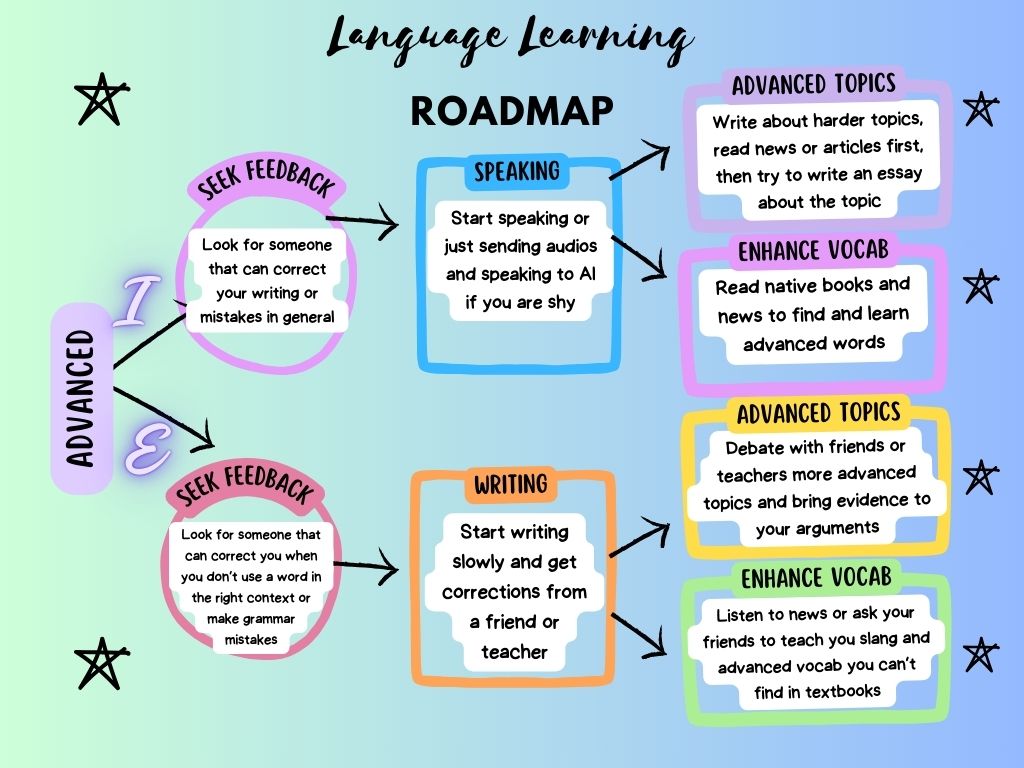
I + E – Seek feedback. At this stage, looking for someone to help you improve and understand the advanced vocabulary and grammar is essential.
I – If you haven’t done it yet, it is finally time to talk to people. Trust me, you know the language well enough! Don’t be afraid to make mistakes and get corrections. You can do it.
~Reading and listening to news and more advanced topics will enhance your vocabulary and make you truly fluent in the language.
~You have been practicing writing more than the extrovert, so at this stage try to write about more complex topics. Start by reading an article or any news, write down new vocab and its meaning if it’s easier and then, try to write down your opinion about the topic. Do this until you can write a formal essay in that language.
E – You focused on speaking so far, so try writing from time to time too. Pick a topic you like, write a short text about it and ask friends and teachers for corrections.
~For speaking, keep doing what you have been doing until now: speak, speak, speak! Debate with your friends advanced topics like the economic state of your country, if children should wear uniforms to school or not or if AI will take over the world or not.
We tried to provide a detailed guide on learning a language, one that will fit one’s personality. Of course, if you are an introvert, you don’t have to follow just the tips meant for your personality and the other way around. And of course, the stages can change, you can start speaking much earlier or much later . Not all the language learning journeys are the same, so find out what works and doesn’t work for you. What works sometimes for Seolhwa might not works for Teri. Language learning is gradual, so enjoy your journey and don’t give up!
 Polyglot besties
Leave a comment